Rock & Boulder Retaining Walls Gold Coast
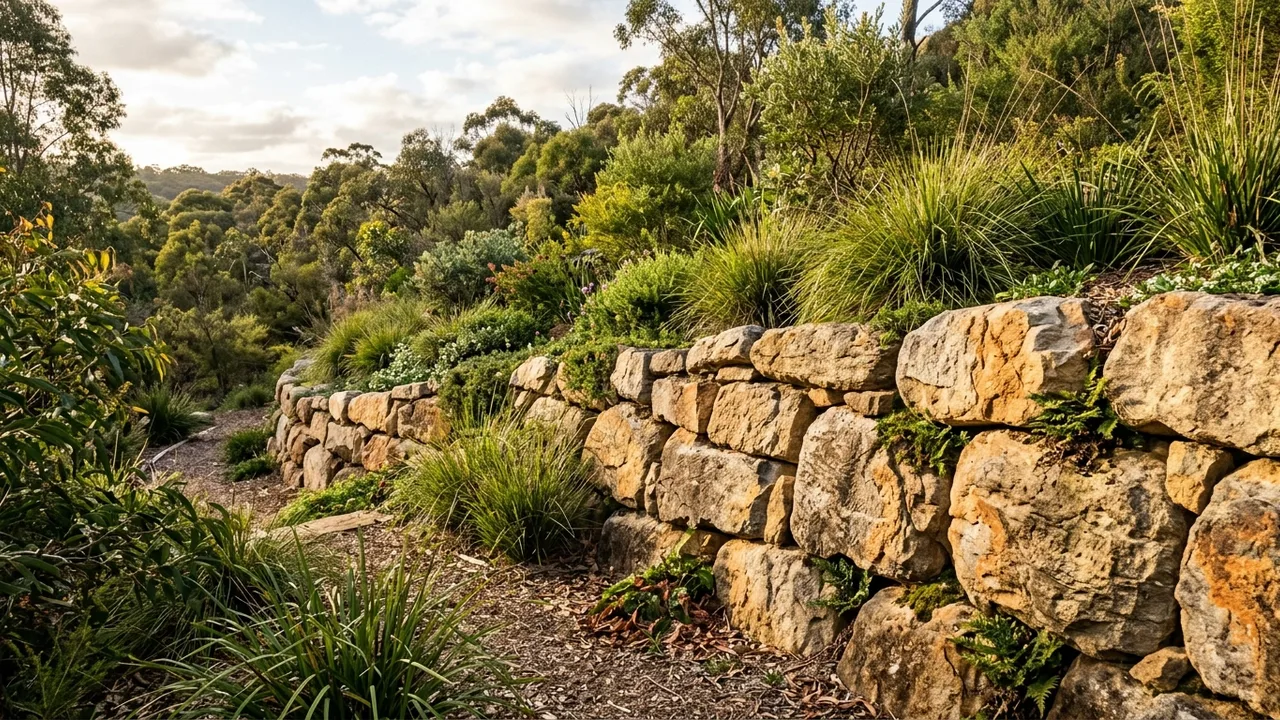
Rock and boulder retaining walls are hand-built from natural sandstone or local boulders to create a premium, organic-looking wall that becomes a landscaping feature in its own right.
Hand-placed sandstone and boulders, Battered back natural face, Gravel and geofabric backing details
Hand-placed sandstone and boulders
Battered back natural face
Gravel and geofabric backing
Your rock and boulder walls contractor checks these details during the project review so they can scope your Gold Coast site accurately.
What rock and boulder walls are
Each stone is selected and placed by eye to create a battered face that relies on mass and interlock to hold the soil back. Sandstone blocks give a refined, uniform finish, while random boulders suit a more rustic, bush-garden look. A free-draining backing of gravel and geofabric is placed behind the face.
When to choose rock and boulder walls on the Gold Coast
This style is chosen when aesthetics are as important as structure, such as front yards, feature garden walls, pool surrounds and prestige properties in suburbs like Bundall, Broadbeach Waters and Tamborine Mountain. It works best where there is enough space for the batter and where the stone can be sourced economically.
Cost and durability expectations for rock and boulder walls
Natural stone walls are labour-intensive and vary with stone type and access. Indicative installed rates range from $350 to $750 per square metre, with imported sandstone and large feature boulders at the upper end. Engineering and approval costs are additional for walls over 1.0 metre or carrying surcharge loads.
Council approval and engineering for rock and boulder walls
Even a dry-stacked rock wall under 1.0 metre must be stable and must not direct concentrated water onto neighbouring land. Taller walls, walls supporting driveways or buildings, and walls close to boundaries generally need RPEQ engineering and council or certifier approval.
How the rock and boulder walls process works
The contractor excavates the footing zone, places and compacts drainage gravel, sets the largest stones at the base, then builds the face course by course to the designed batter. Joints are packed, the backing is wrapped in geofabric, and the ground is graded so surface water flows away.
Typical Gold Coast applications
Natural stone and boulder walls are favoured for feature front yards, native gardens, pool surrounds and bush-block batters where the wall is intended to look like part of the landscape. They suit properties with space for a batter and access for a small excavator or hand placement.
What to confirm for an accurate quote
Stone walls require confirmation of stone type and source, batter angle, footing preparation, drainage backing and access for placement. Because each stone is placed by hand or machine, the estimate is sensitive to wall length, average height and how far stone must be carted.
Lifespan and maintenance expectations
A well-built dry-stacked stone wall can last several decades, with sandstone generally outlasting random field boulders. Maintenance is mostly cosmetic: replacing shifted stones after heavy rain, topping up gravel behind the face and keeping drainage paths clear. A slight backward batter and free-draining backing are what let the wall settle naturally without losing stability.
Rock & Boulder Retaining Walls across Gold Coast
Rock and boulder retaining walls are hand-built from natural sandstone or local boulders to create a premium, organic-looking wall that becomes a landscaping feature in its own right. The map below links to the Gold Coast suburbs where contractors most often quote for rock and boulder walls.